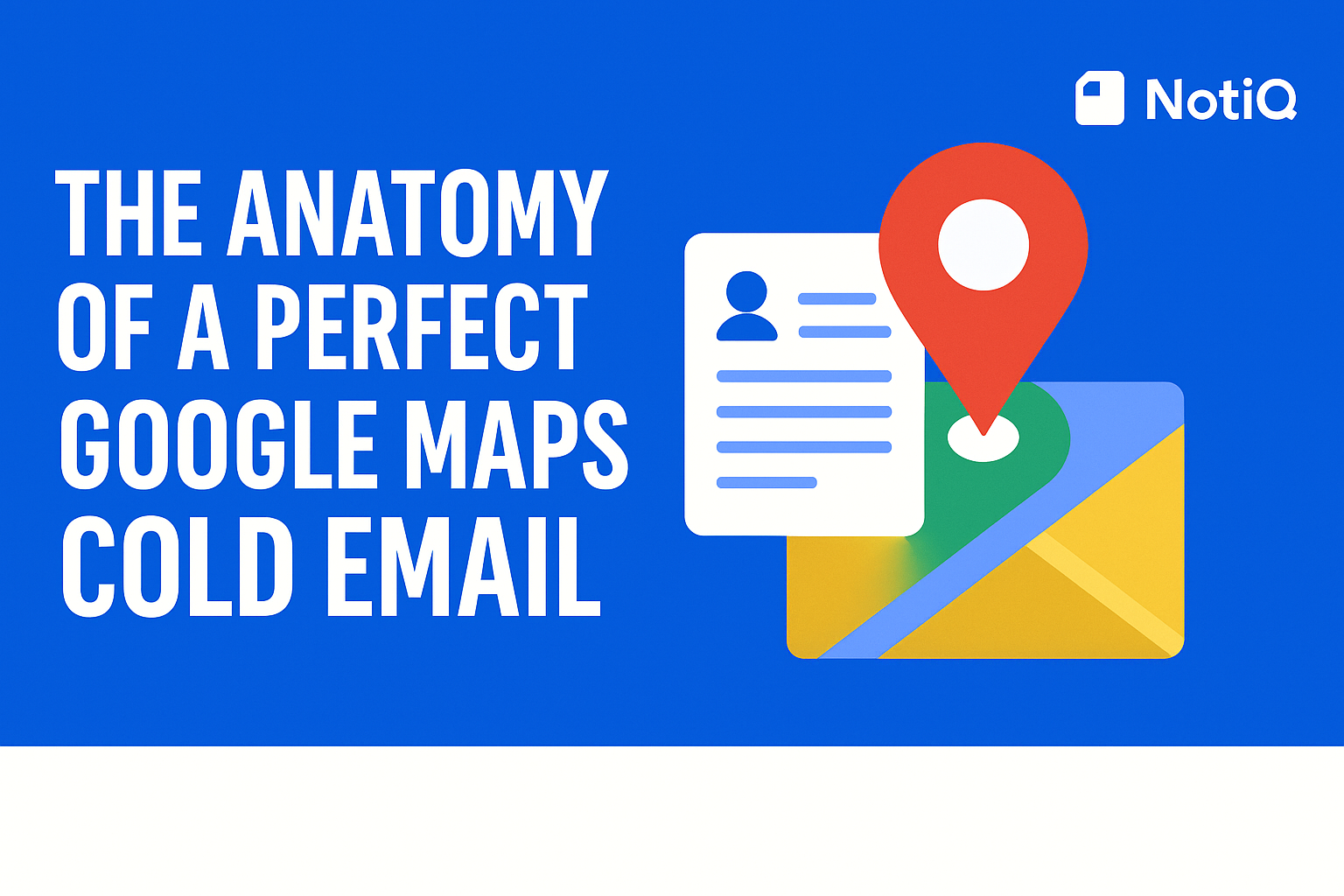
The Anatomy of a Perfect Google Maps Cold Email (Templates Included)
Introduction
Most Google Maps cold emails fail before they are even opened. If they do get opened, they often die at the first line: "I found your business on Google Maps and wanted to see if you need SEO."
This approach is generic, lazy, and instantly signals to the business owner that you have sent the exact same message to 500 other competitors in their area. In the high-stakes world of local lead generation, generic outreach is the fastest route to the spam folder.
However, Google Maps remains one of the most potent databases of high-intent leads available—if you know how to use it. The secret isn't just finding the business; it is using the rich data visible on their listing to craft a message that feels hand-written and hyper-relevant.
This guide will teach you the anatomy of a perfect cold email. We will break down the psychology of local business owners, provide a framework for deep personalization, and share proven templates you can copy and paste. Drawing from NotiQ’s experience analyzing thousands of cold emails across various niches, we will show you how to turn visible Google Maps details into high-response outreach campaigns.
Table of Contents
- Why Google Maps Cold Outreach Works
- How to Personalize Emails Using Google Maps Data
- Proven Google Maps Cold Email Templates
- Deliverability and Follow-Up Best Practices
- FAQ
Why Google Maps Cold Outreach Works
Cold outreach via Google Maps is effective because the leads possess high commercial intent. Unlike buying a generic data list where half the businesses might be defunct, a Google Maps listing usually indicates an active, operating business trying to attract local customers.
Local businesses, from plumbers to bistros, live and die by their local visibility. They struggle with inconsistent leads and the constant pressure to appear in the "Local Pack" (the top three map results). When you approach them with a solution that addresses their visibility or reputation, you are speaking directly to their survival instincts.
While many competitors rely on "spray and pray" automation—blasting thousands of generic messages—a manual or semi-automated approach that leverages specific details wins every time. It cuts through the noise because it proves you are a human who actually looked at their business.
For those looking to streamline this process without losing the personal touch, NotiQ serves as a practical resource for template-based outreach, helping you organize leads and monitor brand mentions to time your emails perfectly.
The Psychology of Local Business Owners
To write a perfect email, you must understand who is reading it. Local business owners are notoriously time-poor. They are often wearing multiple hats—managing staff, handling finances, and serving customers.
They receive dozens of sales pitches a week. They do not have the patience for long introductions, jargon, or vague promises. The psychology of a successful map-based email relies on three pillars:
- Brevity: Get to the point immediately.
- Respect: Acknowledge their time.
- Specific Value: Show you know their specific problem, not just a general industry problem.
What Makes Google Maps Better Than Other Prospecting Sources
Google Maps offers a visual dashboard of a business's health that you cannot get from a simple spreadsheet.
- Reviews and Ratings: You can instantly see if they have a reputation problem (low stars) or a volume problem (few reviews).
- Photos: You can see if their menu is blurry, their storefront photo is outdated, or if they lack high-quality images entirely.
- Hours and Seasonality: You can see if they are open late or if they are entering their busy season.
This data provides "instant personalization cues." You don't need expensive scraping tools or complex software to find these hooks; they are publicly available, making this the most beginner-friendly prospecting method available.
How to Personalize Emails Using Google Maps Data
Personalization is not just inserting the {{First_Name}} variable. True personalization proves you did your homework. When prospecting on Google Maps, you should act like a detective looking for clues that act as conversation starters.
Reviews (Positive, Negative, Missing)
Reviews are the strongest currency on Google Maps. Referencing them in your email creates an immediate psychological bridge.
- The "Ego" Hook (Positive): "I saw you’ve managed to keep a 4.9-star rating across 150 reviews—that’s incredibly hard to do in the HVAC space."
- The "Gap" Hook (Missing): "I noticed you’re one of the top-rated cafes in the area, but you only have 12 reviews compared to your competitor's 200."
- The "Fix" Hook (Negative): "I was reading your reviews and noticed a few customers mentioned the phone lines are always busy."
Recent research on personalization effects in email engagement suggests that tailoring content to specific recipient attributes significantly increases open and response rates compared to generic messaging.
Photos, Menus, and Visual Cues
For industries like hospitality, real estate, and home services, visuals are everything.
- Restaurants: Look for photos of menus that are hard to read or food photos that look unappealing (bad lighting).
- Contractors: Check if they have "before and after" photos uploaded. If not, that is your angle.
- Retail: Look for outdated storefront images or holiday decorations visible in July.
Example Line: "I was checking out your listing on Maps and noticed the menu photo is a bit blurry—I help restaurants digitize these so customers can read them easily on mobile."
Hours, Popular Times, and Seasonality
Google provides "Popular Times" data and operating hours. Mismatched hours are a common pain point for customers and a great entry point for you.
- The "After Hours" Angle: "I see you offer 24/7 emergency plumbing, but your Google Maps listing says you close at 5 PM. You might be losing late-night calls."
- Seasonality: "With summer approaching, I know your AC repair inquiries are about to spike."
Missing Website, Social Links, or Booking Buttons
Many local businesses have a Google Business Profile but lack a website or a functional booking link. This is a critical gap in their funnel.
- The "Friction" Angle: "I found you on Maps but couldn't find a link to book an appointment directly. I help clinics set up 'one-click' booking."
If you are expanding your outreach beyond Google Maps to platforms like LinkedIn to find the owner's direct contact info, ensure you are using a strategy that complements your local data. You can read more about mastering LinkedIn cold outreach to combine these methods effectively.
Proven Google Maps Cold Email Templates
Below are tested templates designed for speed and readability. Remember: the best template is one you adapt to your voice. Keep them under 120 words to ensure they are mobile-friendly.
Universal Google Maps Personalization Template
This framework works for almost any service. It relies on a "Observation + Value + Ask" structure.
Subject: Question about your Google Maps listing
Hi [Name],
I came across [Business Name] on Google Maps while looking for [Industry] in [City].
I noticed [Specific Observation from Maps: e.g., "you have great reviews but no link to your website"].
I help businesses like yours fix this to get more [Specific Benefit: e.g., "direct bookings"]. We just helped [Competitor/Similar Client] get [Result].
Are you open to a quick video showing how we could fix that link for you?
Best,
[Your Name]
Templates by Niche
Plumbers / Home Services
Subject: Missed emergency calls?
Hi [Name],
Saw [Business Name] on Google Maps. Impressive to see a 4.8 rating with over 50 reviews.
However, I noticed your listing hours are set to 9-5, even though your description mentions "24/7 Emergency Service." You might be losing late-night leads to competitors who show as "Open" on Maps.
I fix listing discrepancies for local plumbers to maximize call volume. Worth a quick chat to correct this?
Thanks,
[Your Name]
Dentists / Medical
Subject: Patient booking flow for [Practice Name]
Hi Dr. [Name],
I found your practice on Google Maps. The patient feedback on your staff’s friendliness is stellar.
I did notice there’s no direct "Book Online" button on your profile—patients have to call in, which often leads to drop-offs.
I help dental practices install automated booking directly on Maps. It typically increases new patient appointments by 20% in month one.
Open to seeing how it works?
Best,
[Your Name]
Cafes / Restaurants
Subject: Your menu photos on Google
Hi [Name],
I’m a local foodie and found [Restaurant Name] on Maps. The reviews for the lasagna look amazing.
I noticed the current menu photo uploaded to your listing is a bit blurry and from 2021. Since 70% of diners check the menu online before visiting, this might be turning people away.
I’m a local photographer offering a "Google Maps Refresh" package. Can I swing by this week to show you what I do?
Cheers,
[Your Name]
Contractors / Landscapers
Subject: Showcase your recent projects?
Hi [Name],
Just saw [Business Name] on Maps. You’ve been serving [City] for a long time—congrats on the longevity.
I noticed your listing doesn't have any photos of your recent deck projects, only the storefront. Homeowners love seeing "Before & After" shots before they call.
I help contractors automate their portfolio uploads so your Maps listing always looks active.
Mind if I send over a 1-minute video explaining how?
Best,
[Your Name]
A/B Tested Short-Form Templates (Under 60 Words)
Sometimes, less is more. These "SMS-style" emails respect the owner's time and often get higher reply rates because they feel casual.
Option 1: The "Quick Fix"
Subject: Quick question re: Google Maps
Hi [Name],
I noticed a broken link on your Google Maps profile for [Business Name].
I fix these for local businesses so they don't lose traffic. Mind if I send over a screenshot of exactly where the error is?
Best,
[Your Name]
Option 2: The "Review" Angle
Subject: Your 5-star rating
Hi [Name],
Saw you just hit 100 reviews on Google Maps—congrats.
I have a system that helps leverage those reviews to get more referrals automatically. Are you taking on new clients right now?
Thanks,
[Your Name]
Rewrite Teardowns from Real Google Maps Listings
Here is how to take raw data and turn it into a winning email.
Listing 1: "City Yoga Studio"
- Observation: 4.2 stars, but the last 3 reviews complain about "class schedule not updated."
- The Email:
"Hi [Name], saw City Yoga on Maps. Love the location. I noticed a few recent reviews mentioned confusion over the class schedule. I help studios sync their booking software to Google Maps so the hours are always perfect. Want to stop those complaints for good?"
Listing 2: "Downtown Auto Repair"
- Observation: No website link. 15 photos of cars, but no photos of the waiting room or staff.
- The Email:
"Hi [Name], found Downtown Auto on Google. You have great photos of the repairs, but none of the team! Trust increases when customers see the mechanics. I help shops build trust-based profiles. specific Academic study on email response prediction shows that personalized, trust-based language drastically improves reply probability. Open to a tip on improving your profile images?"
Deliverability and Follow-Up Best Practices
You can write the perfect email, but it is useless if it lands in the spam folder. For beginners, deliverability is about technical hygiene and content restraint.
Simple Deliverability Checklist for Beginners
Before you send your first campaign, ensure you aren't looking like a bot to Google or Outlook.
- Technical Setup: Ensure you have set up SPF, DKIM, and DMARC records. These are like digital ID cards that tell email providers you are who you say you are.
- Plain Text: Avoid fancy HTML templates, large logos, or attachments in the first email. Keep it text-only.
- Low Volume: If your domain is new, start by sending 10-20 emails a day, not hundreds.
- Clean Links: Avoid using link shorteners (like bit.ly) which are often flagged as spam.
For a deeper dive into maintaining a clean reputation, refer to these nonprofit email marketing best practices, which apply excellently to cold outreach regarding trust and deliverability.
CAN-SPAM Essentials
Compliance is non-negotiable. The CAN-SPAM Act sets the rules for commercial email. Even for cold outreach, you must adhere to these principles:
- Don't use deceptive subject lines. (e.g., Don't write "Re: our meeting" if you never met).
- Identify the message as an ad. (The context usually makes this clear).
- Tell recipients where you’re located. Include a valid physical postal address.
- Tell recipients how to opt out. You don't need a fancy "Unsubscribe" button, but you must include a line like "Reply 'No thanks' if you don't want to hear from me."
For the official legal text, consult the FTC CAN-SPAM compliance guidelines.
Follow-Up Cadence for Local Businesses
Local business owners are busy, not necessarily uninterested. The money is in the follow-up.
- Day 1: Initial personalized email.
- Day 4: Short bump. "Hey [Name], just floating this to the top of your inbox. Did you see the note about the menu photos?"
- Day 8: Value add. "Here is a quick example of a listing we optimized recently."
- Day 14: Break-up email. "I won't keep pestering you. Let me know if you ever want to fix that map listing."
Mini Toolkit for Readers
Before you hit send, run through this Google Maps Outreach Checklist:
- [ ] Does the business have a "Claim this business" badge? (If yes, they haven't claimed it—huge opportunity).
- [ ] Are the hours accurate?
- [ ] Is there a website link?
- [ ] Are there recent reviews (last 30 days)?
- [ ] Is the phone number local?
The One-Line Personalization Generator:
"I noticed [Observation from Map] which usually causes [Pain Point], so I wanted to suggest [Solution]."
Conclusion
Google Maps cold outreach works because it bridges the gap between digital prospecting and real-world observation. By using the public data available on every listing—reviews, photos, and hours—you can craft messages that are impossible to ignore because they are hyper-relevant.
The days of generic "Dear Business Owner" emails are over. Use the templates provided above, focus on specific "hooks" found on the map, and always prioritize value over the hard sell. If you are ready to scale your outreach with better data and organization, explore the tools available at NotiQ to take your campaigns to the next level.
FAQ
How do I cold email businesses found on Google Maps?
Find the business on Maps, identify a specific issue or opportunity (like missing photos or bad reviews), find their email address via their website or a finder tool, and send a short, personalized message referencing exactly what you saw on their listing.
What should I include in a Google Maps outreach email?
Always include a "hook" based on their map data (e.g., "I saw your 4.8-star rating"), a clear value proposition (how you can help them improve that rating or get more leads), and a low-friction Call to Action (e.g., "Open to a short video?").
How do I avoid spam filters when emailing Google Maps leads?
Ensure your technical setup (SPF/DKIM/DMARC) is correct, send emails in low volume (warm up your inbox), avoid spam trigger words (like "free," "guarantee," "buy now"), and keep your email text-based without heavy images or attachments.
How many follow-ups should I send?
A sequence of 3–4 emails is ideal. Space them out by 2 to 4 days. Keep them polite and professional. If they don't reply after the fourth email, move on to the next prospect.
Can I automate Google Maps outreach?
Yes, but proceed with caution. While you can automate the finding of leads and the sending of emails, the personalization (the specific observation about their listing) should be done manually or with high-quality data enrichment to ensure high response rates.
.svg)