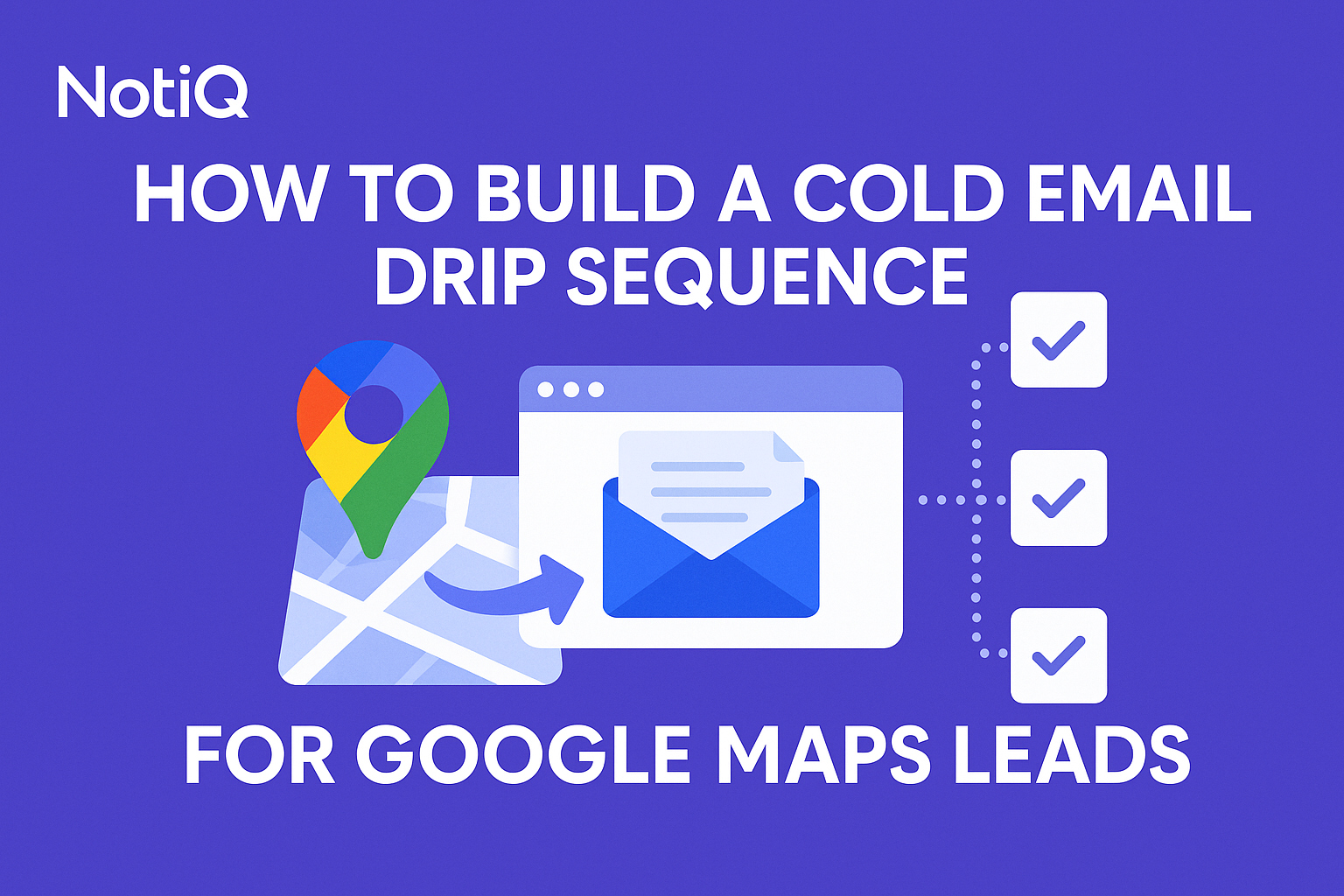
How to Build a Cold Email Drip Sequence for Google Maps Leads (Beginner-Friendly Blueprint)
Beginners often waste countless hours manually copying data from Google Maps, only to send generic, copy-pasted emails that get ignored. You might have a list of 500 local plumbers or dentists, but if your email reads like a corporate blast to a Fortune 500 CEO, it will land in the trash.
Google Maps-sourced leads require a fundamentally different approach. These are local businesses, often owner-operated, operating in high-competition service areas. They don't have time for fluff, and they can spot a mass-email template from a mile away.
To succeed, you need a strategy that leverages the specific public data available on their profiles. In this guide, we will build a complete 4–6 step cold email drip sequence designed specifically for Google Maps leads. We will cover how to use Google Business Profile (GBP) data for hyper-personalization and set up an automation workflow that scales.
At NotiQ, we have analyzed thousands of outreach sequences across dozens of niches. The data is clear: generic blasts fail, but sequences that respect the local context of the business owner win.
Why Google Maps Leads Need a Different Email Sequence
Local business leads are distinct from the typical B2B SaaS leads found on LinkedIn. When you email a local business found on Google Maps, you are likely reaching the owner directly—someone who is answering phones, managing a crew, and checking emails on their phone between jobs.
These leads have high "local intent." They care about their ranking in the "Map Pack," their local reviews, and their immediate operational headaches. Most competitor guides offer generic "B2B sales" templates that sound robotic and detached. They fail to utilize the rich data available publicly on a Google Business Profile (GBP).
If your email sequence doesn't acknowledge their specific local context—such as their service area, their review count, or their specific business category—you are just another spammer. However, because these are high-intent businesses, the payoff for personalization is massive.
To manage this effectively, you need a system that bridges the gap between raw data and your sending platform. NotiQ helps streamline the transition from data extraction to actionable email sequence workflows, ensuring you aren't just collecting data, but using it to start conversations.
How to Structure a 4–6 Step Drip Sequence for Local Businesses
A "drip sequence" is simply a series of automated emails sent over a period of time until the prospect replies. For local businesses, a 4–6 step sequence is the sweet spot. It demonstrates persistence without becoming harassment.
Industry data suggests that automated follow-ups can increase reply rates by 35–50% compared to sending a single email. Below is the exact structure you should use when crafting a cold email sequence for Google Maps leads.
Email 1 — Personalized Intro Based on GBP Signals
Your first email has one job: prove you aren't a bot. You do this by using the "Observation → Opportunity → CTA" formula.
Instead of saying "I can help with SEO," use a specific observation from their Google Business Profile.
Example:
"Hi [Name], I was looking for plumbers in [City] and noticed your Google Business Profile has a 4.8-star rating but only 2 photos uploaded. I specialize in helping local pros optimize their profiles to rank higher..."
This approach adheres to best practices. According to the Google Business Profile Editing Guidelines, accurate and complete attributes (like photos and hours) are critical for visibility. referencing these public details shows you have done your homework.
Email 2 — Value Proof Without Overpitching
If they didn't reply to the first email, do not just say "bumping this up." Provide value.
In this step of your local business outreach templates, offer a quick audit, a relevant insight, or a "micro-win."
- For a Restaurant: "I saw your menu link is broken on mobile."
- For a Contractor: "I noticed three competitors in [City] are bidding on your main keywords."
Email 3 — Soft CTA to Start a Conversation
By the third email, you want to lower the friction. Shift from a hard pitch to a conversation starter.
Example:
"Would you be open to a 3-minute video walkthrough of how we fixed this for a similar business in [City]?"
This is a vital part of a cold email workflow—giving the prospect an easy way to say "yes" without committing to a sales call.
Email 4 — Case‑Based Follow-Up
Social proof is powerful. In this email, share a specific result relevant to their niche.
Example:
"We recently helped a roofing company in [Neighboring City] get 15 more calls per month by optimizing their GBP categories."
If you are struggling to structure these specific examples, you can find excellent inspiration on how to adapt templates for specific industries. Check out this guide on selling web design services to see how niche-specific sequences are constructed.
Email 5–6 (Optional) — Quick Question or Breakup
If there is still no response, keep it light.
- Email 5: "Are you the right person to speak to about [Topic]?"
- Email 6 (Breakup): "I won't keep flooding your inbox. I'll assume this isn't a priority right now. Feel free to reach out if that changes."
Using Google Business Profile Data for Personalization
The secret to a high-converting cold email drip sequence for Google Maps leads is the data source itself. Google Maps provides a wealth of public information that you can legally use to tailor your message.
You must ensure your outreach respects the platform's rules. Familiarize yourself with the Business Profile Policy Overview to understand how businesses are expected to present themselves, which gives you the context needed to offer helpful, compliant advice.
What to Pull From GBP (Beginner Breakdown)
When viewing a lead on Maps, look for these specific fields to personalize emails using Google Business Profile data:
- Business Name: Essential for the subject line.
- Review Count & Rating: "Congrats on the 5-star rating..."
- Photos: "I noticed you haven't updated your photos in a year..."
- Website Link: Is it missing? Does it lead to a 404 error?
- Business Category: Are they listed as a "Plumber" or "Emergency Plumber"?
- Operating Hours: "I see you offer 24/7 service..."
Turning GBP Signals Into Intro Lines
Here is how to turn those data points into google business profile outreach hooks:
- Missing Website: "I noticed your Google Profile doesn't link to a website. We build simple landing pages for [Niche]..."
- Low Review Count: "You have great service but only 5 reviews, while your top competitor has 50. We help automate review collection..."
- Wrong Category: "I noticed you are listed as a 'General Contractor' but your photos show mostly kitchen remodels. Updating this category could help you rank better..."
Automation Workflow: From Maps Scraping to Scheduled Follow-Ups
Manual copying and pasting is not scalable. To build a sustainable business, you need an automated cold email follow-up system.
Here is the workflow used by pros:
- Extract: Use a tool to legally extract public data from Google Maps (Name, website, phone, review status).
- Enrich: Use a tool or VA to find the owner's email address associated with that business domain.
- Load: Import this data into your sending platform.
- Schedule: Set your drip sequence to fire on days 1, 3, 6, and 10.
While many beginners try to do this manually, connecting these steps allows you to focus on closing deals rather than data entry. NotiQ excels at orchestrating this AI-driven workflow, helping you monitor specific keywords and businesses to trigger these campaigns automatically.
Tools & Steps for Lead Extraction
When looking for a google maps scraper or extraction tool, prioritize those that respect rate limits and only access public-facing data. You want a clean CSV export that includes the GBP columns mentioned above (reviews, categories, etc.) so you can use them as "variables" in your email templates.
Loading and Scheduling Your Campaign
The best workflow for emailing local businesses involves "smart scheduling." Do not send emails at 2 AM. Schedule your automation to send emails between 8 AM and 10 AM in the prospect's local time zone. This ensures your email is at the top of their inbox when they start their day.
Deliverability Tips to Keep Emails Out of Spam
You can have the perfect cold email sequences guide, but it is useless if your emails land in the spam folder. Local businesses often have strict spam filters, and Google is cracking down on bulk senders.
To maintain authority, always refer to the Google Bulk Sender Guidelines to ensure you are compliant with authentication standards. Additionally, use Google Postmaster Tools to monitor your domain reputation.
Domain Setup & Warm‑Up
Before you send a single email, you must set up your technical records:
- SPF (Sender Policy Framework): Authorizes your sending server.
- DKIM (DomainKeys Identified Mail): Adds a digital signature to your emails.
- DMARC: tells servers what to do if an email fails the checks above.
If you skip these, your deliverability will plummet. Furthermore, always "warm up" a new email address by sending a few emails a day and gradually increasing the volume over 2–3 weeks.
Sending Patterns That Protect Reputation
Local businesses prefer a conversational tone. Avoid HTML-heavy emails with flashy images. Stick to plain text.
- Volume: Keep it low. Sending 30–50 highly personalized emails a day is better than blasting 500 generic ones.
- Spacing: Ensure your cold email workflow puts at least 2–3 days between follow-ups to avoid looking like a nuisance.
Conclusion
Building a cold email drip sequence for Google Maps leads doesn't have to be complicated. By shifting your focus from "mass blasting" to "GBP-driven personalization," you instantly separate yourself from the competition.
Remember the 4–6 step structure: Personalize the intro using public data, prove your value, use soft CTAs, and follow up with social proof. Once you have this logic down, you can stop doing it manually.
Ready to stop wasting time on manual outreach? Implement this sequence today and connect your lead sources to an automation tool like NotiQ to scale your results without sacrificing quality.
.svg)