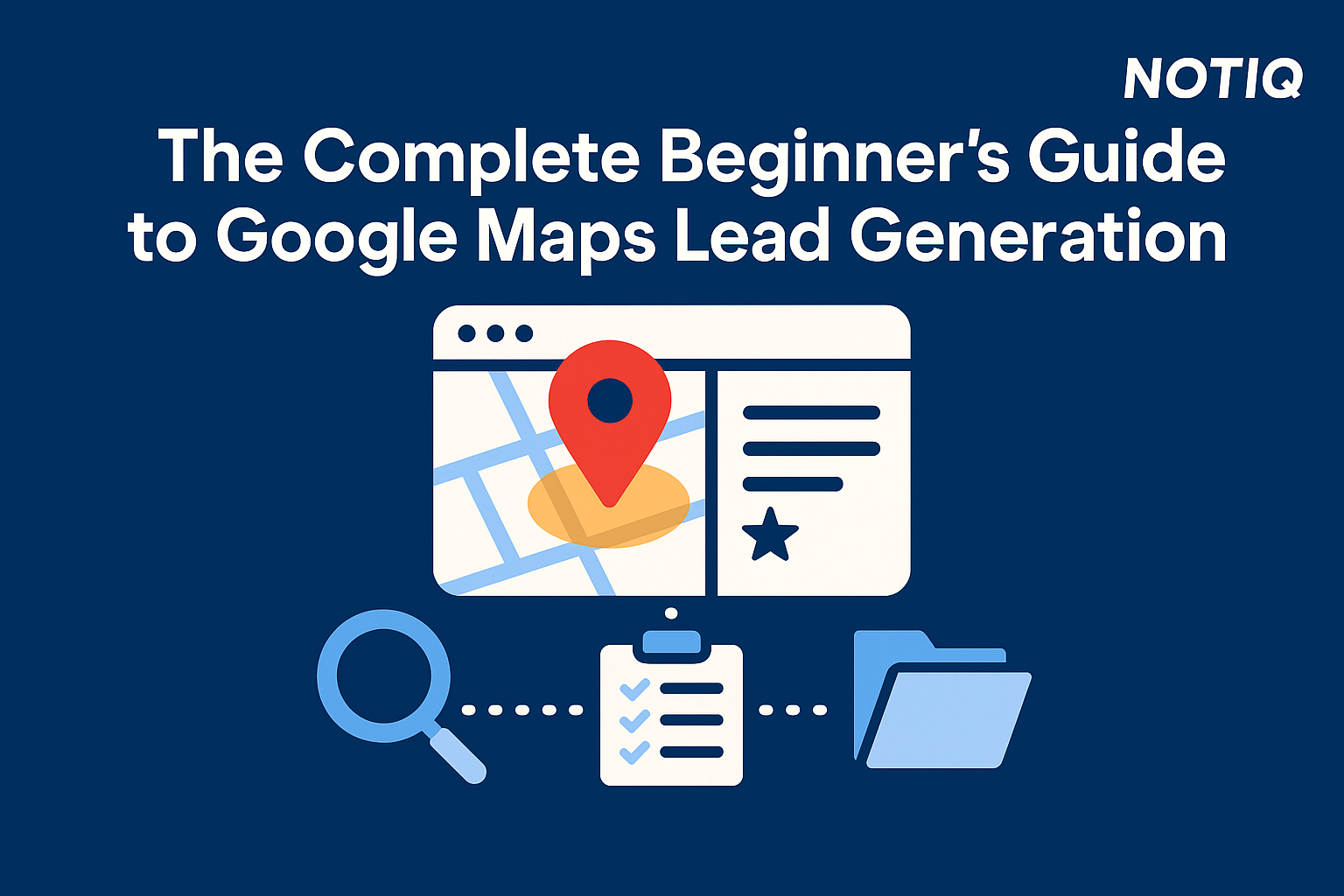
The Complete Beginner’s Guide to Google Maps Lead Generation
For many beginners, starting a lead generation campaign feels like standing at the edge of a dense forest without a compass. You know there are valuable prospects out there, but the path to finding them is cluttered with expensive software, confusing databases, and complex cold outreach strategies.
However, one of the most powerful tools for discovering local business leads is likely already on your phone: Google Maps.
Far more than a navigation app, Google Maps serves as a dynamic, real-time directory of millions of active businesses. For sales professionals, agencies, and B2B marketers, it is a goldmine of publicly available data. When approached correctly, google maps lead generation offers a direct line to local companies that need your services.
In this guide, we will cut through the noise. We will provide a clear, step-by-step workflow for sourcing, qualifying, and organizing leads using Google Maps. Drawing from NotiQ’s experience in teaching beginners simple, effective lead gen workflows, we will show you how to build a prospect list without spending a dime on complex software initially.
For more resources on building these beginner workflows, visit our resource hub at NotiQ.
Table of Contents
- Why Google Maps Works for Local Lead Generation
- A Simple Beginner Workflow for Finding Leads
- How to Collect and Organize Business Info
- How to Qualify and Verify Google Maps Leads
- When to Use Tools to Speed Up Prospecting
- Case Studies or Real Examples for Beginners
- Tools & Resources for Google Maps Lead Generation
- Future Trends & Beginner Predictions
- Conclusion
- FAQ
Why Google Maps Works for Local Lead Generation
Google Maps is often overlooked by beginners in favor of expensive lead databases, yet it remains one of the highest-quality sources for local business lead gen. The reason is simple: accuracy and intent.
Unlike static databases that may be years out of date, Google Maps is a living ecosystem. Business owners are motivated to keep their profiles updated to attract local customers. This means the data you find—phone numbers, websites, and operating hours—is typically more reliable than purchased lists.
Who Is Listed on Google Maps?
Google Maps is specifically designed for businesses that make face-to-face contact with customers, either at a storefront or at the customer's location. This makes it the perfect hunting ground for:
- Home Services: Plumbers, HVAC technicians, landscapers, and roofers.
- Retail & Hospitality: Restaurants, boutiques, coffee shops, and gyms.
- Professional Services: Dentists, chiropractors, lawyers, and accountants.
According to Google’s own guidelines for Business Profile eligibility, a business must have physical contact with customers to be listed. This filter automatically removes many faceless online entities, ensuring your google maps prospecting efforts are focused on real, local operations.
For a beginner, the simplicity of Maps beats the complexity of scraping-first tools. You can see the business, read reviews, and verify their existence instantly—all for free.
A Simple Beginner Workflow for Finding Leads
Success in google maps lead generation for beginners relies on a systematic approach. Randomly clicking pins will lead to disorganized data. Instead, follow this four-step workflow.
Step 1 — Choose Your Niche & Location
Before opening Maps, define exactly who you are looking for. "Small businesses" is too broad. "HVAC repair companies in Austin, Texas" is actionable.
Examples of good beginner niches:
- Niche: Dental practices. Location: Suburbs of Chicago.
- Niche: Boutique hotels. Location: Miami Beach.
- Niche: Solar panel installers. Location: Phoenix.
Defining the service area prevents you from getting overwhelmed and ensures your outreach is relevant to that specific market's needs.
Step 2 — Search Smartly on Google Maps
How you type your query determines the quality of your results. Use "Near Me" logic combined with specific industry terms.
- Explicit Search: "Plumber + [City Name]" (e.g., "Plumber Atlanta").
- Category Search: "Coffee shop near downtown Seattle."
Once the results load, avoid simply clicking the top result. Scroll through the list. Use the "Rating" filter to perhaps find businesses with 3.5 to 4.5 stars—these companies often have a good foundation but need help with reputation management or marketing, making them excellent prospects for map-based lead sourcing.
Step 3 — Review Key Business Info on the Profile
When you click on a business pin, a Knowledge Panel appears. As a beginner, do not get distracted by photos or street views yet. Focus immediately on the "Business Info Collection" essentials:
- Website: Is it linked? Does it look outdated?
- Phone Number: Is it a local area code?
- Hours: Are they currently open?
- Reviews: Do they reply to reviews? (A lack of replies indicates a dormant marketing strategy).
Step 4 — Add Leads to a Simple Tracking Sheet
Never rely on your browser history. You must move data from Maps to a tracking system immediately. Create a simple spreadsheet.
Your columns should be:
- Business Name
- Phone Number
- Website URL
- Review Score
- Status (e.g., "To Contact", "Contacted").
For examples of effective workflow templates and how to structure your tracking, check our guide at NotiQ.
How to Collect and Organize Business Info
Data organization is the difference between a hobbyist and a professional. To master how to collect business info from google maps, you need a standardized entry method.
What Information Matters Most
In the beginning, less is more. You only need enough information to qualify the lead and make contact. Do not waste time copying the business description or every single review.
Essential Fields:
- Name: The exact name as listed on the profile.
- Category: (e.g., "Italian Restaurant").
- Location: City and Zip Code are usually sufficient.
- Website: Crucial for further verification.
- Rating Count: High volume (500+) implies a market leader; low volume (<10) implies a new or struggling business.
Beginner-Friendly Lead Tracking Setup
We recommend using Google Sheets or Excel for your first 100 leads. It is free, searchable, and easy to export later.
Color Coding Tip:
- Green: High-quality lead (Has website, good reviews, active).
- Yellow: Potential lead (No website, but has phone number).
- Red: Disqualified (Permanently closed or bad fit).
This visual aid helps you prioritize your outreach efforts during your "calling blocks" or email drafting sessions. This is the essence of a practical google maps beginners guide to data management.
Avoiding Common Data Collection Pitfalls
A common mistake in google maps prospecting is "Analysis Paralysis." Beginners often spend 15 minutes analyzing one company.
- The Pitfall: Reading every negative review to "understand" the business.
- The Fix: Limit your review time to 60 seconds per lead.
- The Pitfall: Collecting data you won't use (e.g., fax numbers).
- The Fix: Stick to the essential fields listed above.
How to Qualify and Verify Google Maps Leads
Finding a business on Maps is step one. Ensuring they are a viable prospect is step two. This process is called qualification.
Fast Ways to Evaluate a Lead
You can judge the health of a business in seconds by looking at their Google Business Profile.
The "Good Lead" Checklist:
- Photos: Are there recent photos uploaded by the owner? (Indicates activity).
- Reviews: Are there reviews from the last month? (Indicates current customers).
- Website: Does the link work? Is it mobile-friendly?
The "Poor Lead" Signals:
- "Permanently Closed" label.
- A residential address for a business that should have a storefront (unless they are a service-area business like a plumber).
- Unclaimed profile label (though this can sometimes be a sales opportunity for agencies selling profile optimization).
How to Verify Contact Details
Before you reach out, you must verify accuracy. A bounced email or a disconnected phone number wastes time.
- Click the Website Link: Does it match the business on Maps?
- Check the Footer: Look for a matching phone number and address on the website footer.
- Manual Check: For high-value leads, call the number. A simple "Are you open?" check confirms the line is active.
Google places high importance on accuracy. Owners are encouraged to add or claim their Business Profile to verify this data personally. When you see a "Claimed" profile, the data has likely been verified by the owner via postcard or video, increasing your confidence in the lead.
Market & Demand Verification
Is there actually demand for services in the area you are targeting? Before building a list of 500 leads in a small town, check the local economic data.
The Census Business Builder is a fantastic government resource. It allows you to view demographic data and business spending in specific regions. This helps you verify that the local market can support the B2B services you plan to pitch.
When to Use Tools to Speed Up Prospecting
Once you have manually collected your first 50 or 100 leads, you will understand the data structure. Only then should you consider tools.
Manual vs. Tool-Assisted Prospecting
- Manual Prospecting: Best for beginners. It forces you to look at the market. You learn to spot patterns (e.g., "Most dentists in this area don't have websites"). It is 100% accurate because you verify every entry.
- Tool-Assisted: Tools like Apollo or specialized map scrapers are designed for volume. They can extract thousands of leads in minutes. However, without the manual experience, you may end up with thousands of low-quality, unqualified leads.
Light Automation Options for Beginners
If you are ready to scale, look for "light automation" or lead enrichment tools. These tools allow you to input a business name and city, and they return the email address or LinkedIn profile associated with it. This is safer and often more compliant than aggressive bulk scraping.
Always ensure any automation you use respects Google Maps' Terms of Service and data privacy laws.
How NotiQ Fits Into the Beginner Workflow
NotiQ is designed to bridge the gap between manual chaos and organized workflows. We provide the templates, checklists, and tracking logic that beginners need to stay organized without needing enterprise-level software immediately.
If you are unsure which tools fit your stage of growth or need specific workflow answers, check our FAQ section at NotiQ.
Case Studies or Real Examples for Beginners
To make this concrete, let’s look at two hypothetical examples of google maps prospecting in action.
Example 1 — Home Service Leads (Plumbers)
The Search: "Emergency Plumber Denver"
The Find: "Mike’s Rapid Plumbing"
The Profile: 4.2 stars, 15 reviews.
The Clue: The last review was 3 months ago. The website link goes to a Facebook page, not a proper domain.
The Opportunity: This is a strong lead for a web designer or SEO agency. The business is active (good rating) but lacks a professional digital presence.
Action: Add to "High Priority" list.
Example 2 — Professional Services (Dentists)
The Search: "Cosmetic Dentist Seattle"
The Find: "Bright Smile Dental"
The Profile: 4.9 stars, 200 reviews. Photos show a high-end waiting room.
The Clue: They have a website, but the "Appointments" link on Google Maps is empty.
The Opportunity: This is a high-revenue business that is missing a conversion point on their profile.
Action: Add to list for "Booking System Optimization" pitch.
Tools & Resources for Google Maps Lead Generation
To get started, you do not need a credit card. You need discipline and a few free resources.
- Google Sheets / Excel: For tracking.
- Google Maps Desktop Version: Much faster for research than the mobile app.
- NotiQ Templates: For structuring your data.
- Hunter.io (Free Tier): To help find emails associated with the websites you find on Maps.
Note on Automation: While tools exist to "scrape" Maps, we recommend using them only for data enrichment (finding emails for known businesses) rather than bulk extraction, to maintain high lead quality and compliance.
For context on how businesses view their own visibility on Maps, resources like this SBA workshop event highlight how critical Maps is for small business owners—confirming that they care about their presence there.
Future Trends & Beginner Predictions
The landscape of lead generation is shifting. We are moving toward AI-assisted prospecting. In the near future, tools will not just find the lead on Maps; they will analyze the photos to tell you what equipment a restaurant uses or read the reviews to identify customer service pain points automatically.
For beginners, the trend is micro-local targeting. As general inboxes get flooded, hyper-local outreach ("I saw your shop on Main Street next to the library...") will become the most effective way to cut through the noise.
Conclusion
Google Maps is the most accessible, data-rich starting point for local lead generation. It levels the playing field, allowing beginners to find, qualify, and contact real businesses without a massive budget.
Remember the workflow:
- Define your niche.
- Search with intent.
- Qualify using profile signals.
- Organize your data relentlessly.
Do not wait for the perfect tool. Open Maps, find your first 10 prospects, and start building your pipeline today. For more templates, FAQs, and guides to support your journey, visit us at NotiQ.
FAQ
How do beginners start with Google Maps lead generation?
Start by defining a specific niche (e.g., "roofers") and a specific location. Use Google Maps to search for these businesses, manually review their profiles for quality, and record their contact information in a spreadsheet.
How many leads can you realistically get from Google Maps?
There is no hard limit, as Maps covers millions of businesses globally. However, a beginner manually sourcing leads can realistically qualify and record 20–30 high-quality leads per hour.
Do you need tools to collect data from Google Maps?
No. You can start entirely for free using the manual workflow described above. Tools are only necessary when you need to scale to hundreds of leads per day or require automated email enrichment.
What industries work best for Maps prospecting?
Industries with physical locations or local service areas work best. This includes home services (plumbing, HVAC), healthcare (dentists, chiropractors), retail, hospitality, and legal services.
How do you verify if a lead is real before outreach?
Check if the Google Business Profile is "Claimed," verify the phone number works, and ensure the website link leads to an active, relevant domain. Checking the date of the most recent review also indicates if the business is currently active.
.svg)