How to Use Google Maps to Pre‑Qualify Leads for SEO, PPC, and Social Ads Agencies
For digital agencies, the biggest bottleneck isn't finding businesses—it's finding the right businesses. Sales teams often waste dozens of hours manually auditing prospects only to discover they have no budget, no intent, or no digital footprint to build upon.
While many agencies rely on expensive, static databases that are often months out of date, Google Maps offers a real-time, dynamic view of a local market’s health. It provides immediate "digital maturity clues" that instantly reveal whether a prospect is a prime candidate for SEO, ready for PPC scaling, or in desperate need of a social media overhaul.
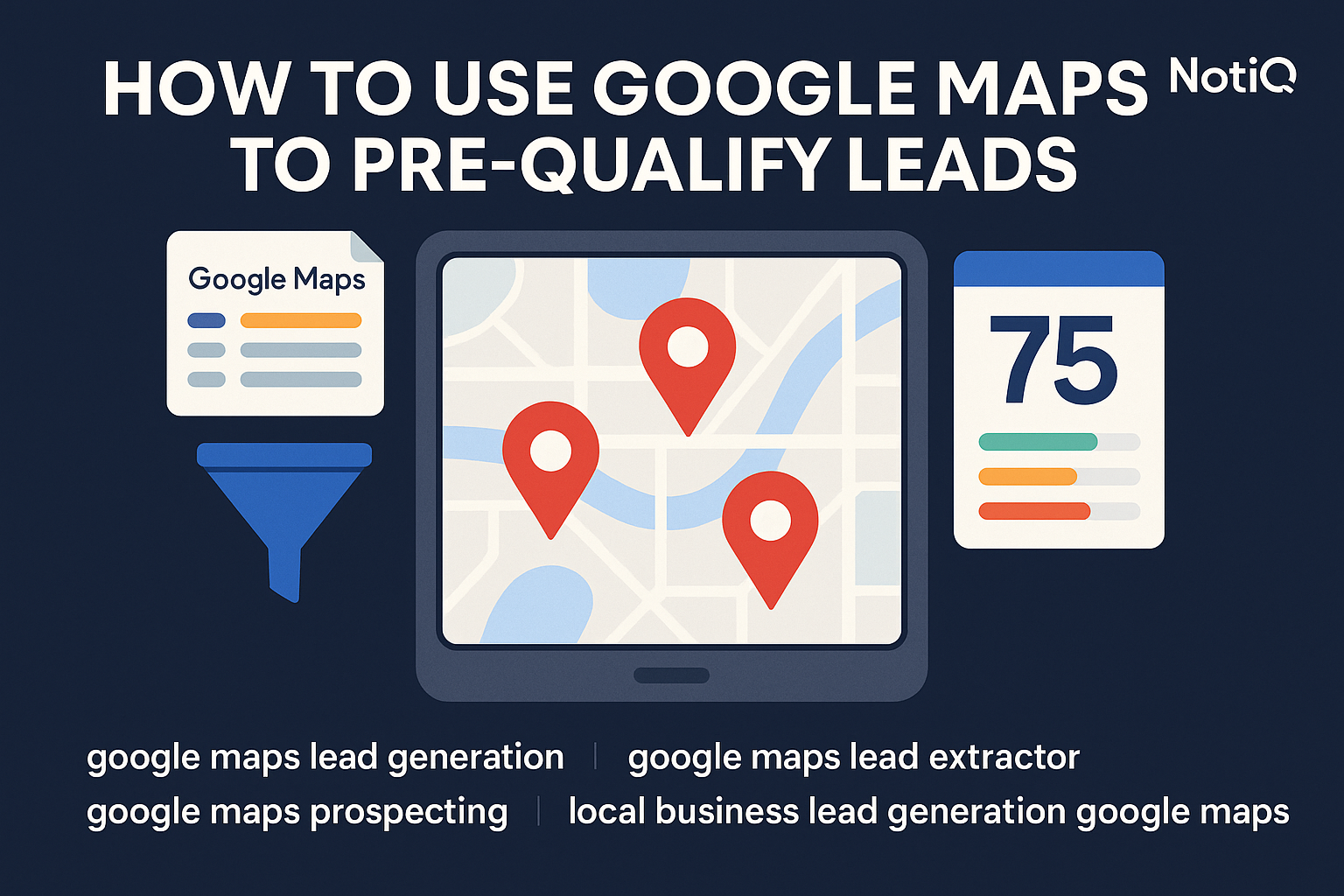
This article delivers a structured framework to transform Google Maps from a simple navigation app into a high-precision prospecting engine. We will cover a lead scoring methodology, competitor density evaluation, and how to automate this process using tools like NotiQ to build high-quality outreach lists compliant with modern standards.
Table of Contents
- Why Google Maps Is the Most Underrated Prospecting Tool
- How to Read Digital Maturity Signals Directly from Maps Listings
- A Step-by-Step Scoring Framework for SEO, PPC, and Social Leads
- Using Competitor Density and Review Patterns to Prioritize Outreach
- Automating Qualification with Enrichment Tools
- Conclusion
- FAQ
Why Google Maps Is the Most Underrated Prospecting Tool
Most prospecting tools scrape data and store it in static databases. By the time you access it, the business might have closed, changed owners, or already hired an agency. In contrast, Google Maps is a living ecosystem updated daily by business owners, customers, and Local Guides.
For agencies, this real-time visibility is critical. Maps allows you to spot operational gaps that paid tools often miss. You can instantly see if a "temporarily closed" tag has been removed, if a website link is broken, or if a sudden influx of negative reviews is threatening a brand's reputation. These are immediate pain points that generic lead lists cannot capture.
Unlike broad manual scraping which yields quantity over quality, targeting via Maps allows for geographic and categorical precision. You aren't just finding "dentists in Chicago"; you are finding "dentists in Chicago with 4.8 stars but no website link." This specificity allows for hyper-personalized outreach that speaks directly to a solveable problem.
To ensure your data interpretation remains accurate, it is helpful to understand the baseline data structures provided by the Google Maps Platform documentation. Understanding these fields helps agencies distinguish between a verified owner update and user-generated content.
However, navigating Maps manually is time-consuming. This is where integrating a tool like NotiQ becomes essential. By treating Maps as the raw data source and NotiQ as the streamlined workflow engine, agencies can extract these insights at scale without the manual drudgery.
How to Read Digital Maturity Signals Directly from Maps Listings
A Google Business Profile (GBP) is a proxy for a company's digital maturity. The completeness of a profile often correlates directly with the owner's sophistication and willingness to invest in marketing.
When auditing a lead, look for the "Digital Trio":
- Visuals: Are the photos professional or grainy smartphone uploads?
- Operations: Are hours accurate? Is the "From the business" description filled out with keywords?
- Reputation: Is the owner responding to reviews?
According to research on consumer habits by Pew Research Center, user trust is heavily influenced by digital presence and verification. A business ignoring these signals is likely losing market share, making them an ideal candidate for education-based selling.
Once you identify these signals, the next step is outreach. For deep personalization strategies based on these specific maturity signals, refer to the guides at Repliq.
Listing Completeness as a Proxy for Marketing Investment
An incomplete listing is rarely an accident; it is a sign of neglect or lack of knowledge.
- Missing Website Link: The ultimate SEO opportunity. If they rely solely on a phone number, they are invisible to 60%+ of searchers.
- Unclaimed Profiles: The "Own this business?" badge is a green light for agencies. It means no one is managing their digital front door.
- Generic Categories: A specialized orthodontist listed simply as "Dentist" is missing valuable search traffic.
These gaps are your entry point. Your pitch isn't "we do SEO"; it's "you are currently invisible for [Specific High-Value Keyword] because your category is wrong."
Reviews as Predictors of Growth Stage
Review counts tell a story about business longevity and capacity.
- 0–10 Reviews: New business or "ghost" business. High risk, but potentially high reward if they have capital.
- 10–50 Reviews: Validated local SMB. Likely profitable but hitting a growth ceiling. Prime target for local SEO.
- 100+ Reviews: Established player. If their rating is below 4.0, they need Reputation Management. If it’s 4.8+, they are ready for PPC or Social Ads to scale.
Website and Posting Activity
Google Posts (updates on the profile) reveal the owner's mindset. A profile with weekly posts indicating offers, team photos, or news suggests an owner who understands activity equals visibility.
Conversely, a profile where the last post was in 2021 indicates digital stagnation. This creates a clear "before and after" narrative for your sales pitch.
A Proven Framework for Scoring SEO, PPC, and Social Leads
To stop wasting time on bad leads, agencies need a unified scoring system (0–100). This score dictates whether a lead goes to a senior closer, a junior SDR, or an automated nurture sequence.
We recommend weighting your score based on:
- Review Quality (30%): Can they handle new traffic?
- Listing Completeness (20%): Low completeness = High SEO opportunity.
- Website Quality (30%): Is the destination page conversion-ready?
- Competitive Pressure (20%): Are they surrounded by aggressive competitors?
To operationalize this, you can use NotiQ as the recommended workflow automation layer to calculate and append these scores automatically before you ever pick up the phone.
SEO Readiness Indicators
- Score Profile: High Intent, Low Visibility.
- Signals: Unclaimed listing, missing "Services" tab, inconsistent Name-Address-Phone (NAP) data across the web, rating below 4.2.
- The Pitch: "Your competitors are ranking for 'emergency plumber' because your profile lacks basic optimization. We can fix this foundation."
PPC Opportunity Indicators
- Score Profile: High Visibility, High Competition.
- Signals: 4.5+ star rating, professional photos, clear service menu, located in a dense competitive zone.
- The Pitch: "You have the reputation to convert leads, but you are relying on organic reach. Your competitors are buying the top spot. Let’s capture that high-intent traffic."
Social Ads Opportunity Indicators
- Score Profile: Visual Product, Weak Branding.
- Signals: Industries like MedSpas, Gyms, Restaurants, or Interior Design. They have good reviews but poor or outdated photos on Maps.
- The Pitch: "Your customers love you, but your digital visuals don't reflect your premium service. We can target lookalike audiences on Instagram to drive bookings."
Using Competitor Density and Review Patterns to Prioritize Outreach
Context is everything. A dentist with 20 reviews in a rural town is a market leader. That same dentist in downtown Manhattan is invisible. You must analyze leads relative to their neighbors.
Understanding local market saturation is key. You can reference U.S. Census geographic data to correlate population density with business density. Furthermore, the SBA provides guidance on competitive analysis that agencies can adapt for digital scouting.
How to Map Competitor Clusters
Visualizing "Red Oceans" vs. "Blue Oceans" helps you choose your strategy.
- Red Ocean (High Density): 20+ businesses in a 1-mile radius offering the same service.
- Strategy: Pitch PPC and aggressive differentiation.
- Blue Ocean (Low Density): 1–3 businesses serving a large residential area.
- Strategy: Pitch SEO domination. It is easier to rank #1 here, offering a quick win for the client and a great case study for you.
Review Velocity and Sentiment Diagnostics
Review velocity—the speed at which new reviews come in—is a pulse check.
- Spikes: A sudden jump in reviews usually means they ran a promotion or hired a consultant. They are spending money.
- Stagnation: No reviews for 6+ months suggests the business is coasting or struggling.
- Sentiment Drop: If a 4.8-star business suddenly gets three 1-star reviews, they are in crisis mode. A timely email offering reputation management can convert instantly.
Automating Qualification with Enrichment Tools
Manual analysis is not scalable. To build a predictable pipeline, you must automate the extraction and scoring process. This involves exporting Google Maps data and "enriching" it with contact details (emails, LinkedIn profiles) and tech stack data (pixels, CMS used).
Compliance Note: Automation must always respect Terms of Service and privacy laws. Refer to the NIST AI Risk Management Framework for best practices on responsible data processing and automation.
Once you have your raw list, personalization is key. For examples on how to merge this data into compelling copy, read about outbound strategies for SEO agencies.
How NotiQ Fits into the Workflow
NotiQ acts as the bridge between raw Maps data and your CRM.
- Search: You define the parameters (e.g., "HVAC in Austin").
- Enrich: NotiQ validates the business status and finds associated contact info.
- Score: It applies your pre-set criteria to flag "High SEO Potential" vs. "High PPC Potential."
- Export: Clean data flows directly into your outreach tool.
Reducing Manual Qualification by 70%+
By automating the "grunt work" of checking website links, counting reviews, and verifying business status, your sales team reclaims 70% of their day. Instead of qualifying leads, they spend their time talking to business owners who are already pre-vetted and likely to buy.
Conclusion
Google Maps is more than a directory; it is a transparent ledger of local business performance. For agencies, it provides the exact data needed to move from generic cold calling to strategic, insight-led consulting.
By analyzing listing completeness, review velocity, and competitor density, you can segment leads into clear buckets: SEO-ready, PPC-ready, or Social-ready. However, to do this at scale without burning out your team, you need the right infrastructure.
Stop guessing which leads are worth your time. Use NotiQ as your enrichment and scoring layer to turn Google Maps into your agency’s most powerful revenue engine.
FAQ
Frequently Asked Questions
What makes Google Maps better than paid tools for prospecting?
Google Maps offers real-time data. Unlike paid databases that may not update for months, Maps reflects the current operational status, recent reviews, and immediate market presence of a business.
How do agencies know if a business is PPC-ready?
A business is generally PPC-ready if they have a strong reputation (4.5+ stars), a functional website, and operate in a competitive area where organic reach is difficult. They need fuel (ads) for their existing engine.
What signals show strong SEO opportunity?
Low listing completeness, missing website links, unclaimed profiles, and a lack of specific service categories are strong indicators that a business is under-optimized and needs SEO help.
How can Maps data improve cold outreach personalization?
You can reference specific data points: "I saw you have 4.9 stars but no website link," or "I noticed you haven't posted an update in 6 months." This proves you actually looked at their business.
How can I automate the entire Maps → outreach workflow?
Use a tool like NotiQ to find and enrich leads from Maps, score them based on your criteria, and export them to your CRM or cold email software for immediate enrollment in a sequence.
.svg)