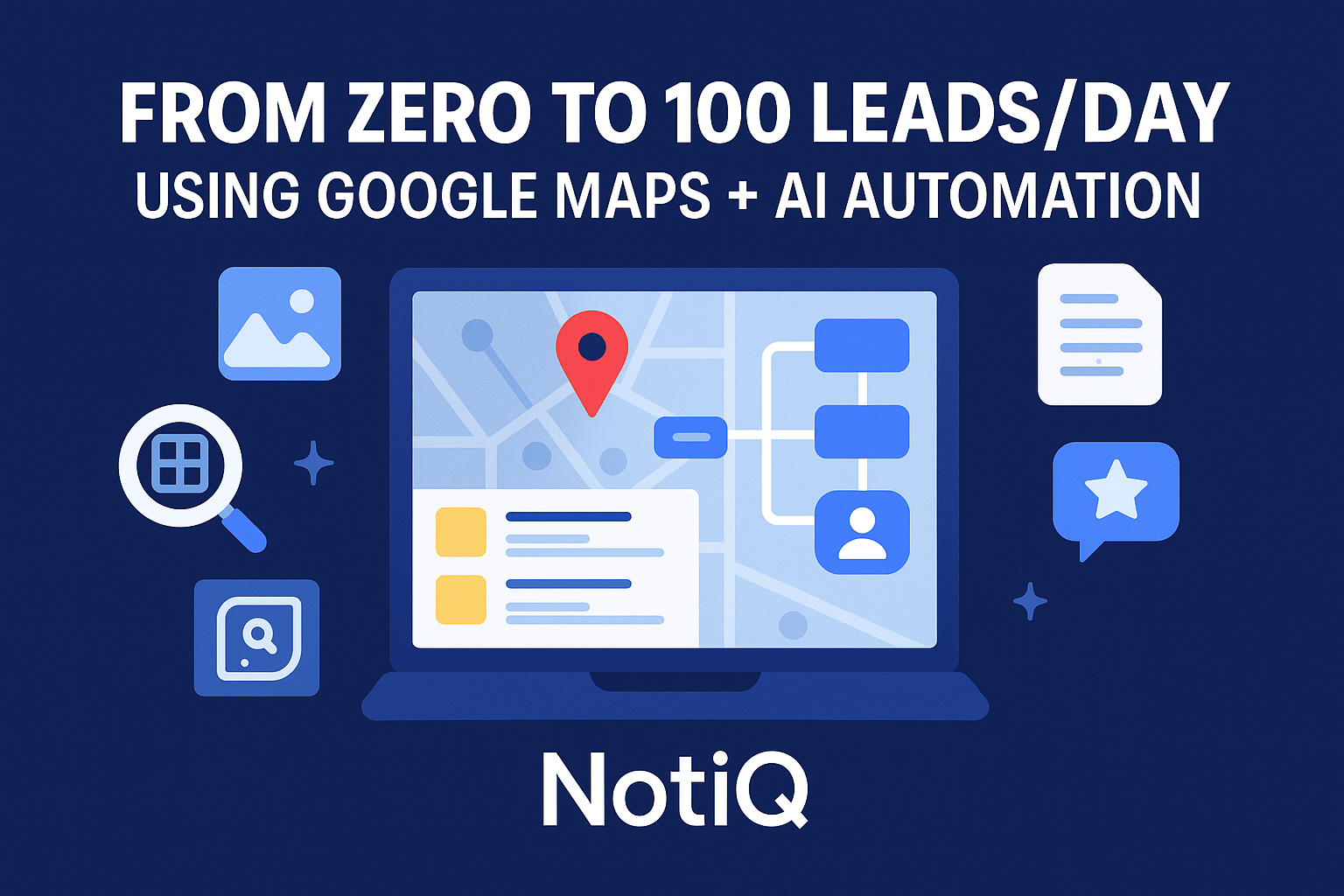
How to Generate 100 Leads/Day from Google Maps Using AI-Powered Automation
For years, local lead generation was a manual grind. Sales development representatives (SDRs) and agency owners spent hours copy-pasting business names, phone numbers, and addresses from Google Maps into spreadsheets, only to find half the data outdated or irrelevant. It was slow, prone to error, and impossible to scale.
Today, the landscape has shifted entirely. The combination of cloud-based automation and Large Language Models (LLMs) has transformed Google Maps from a static directory into a dynamic, high-volume engine for growth. It is now possible to build a fully automated workflow that extracts, enriches, qualifies, and initiates outreach to leads—scaling predictably to 100 leads/day or more without manual intervention.
However, scaling requires more than just a scraper; it requires an intelligent system that can navigate complex data signals and deliver only sales-ready prospects. This is where NotiQ distinguishes itself as the only AI-first, end-to-end workflow engineered specifically for high-volume Google Maps prospecting, eliminating the need for fragmented tool stacks.
Intro to NotiQ as the AI workflow engine
Why Google Maps Is a High-Intent Lead Generation Goldmine
While LinkedIn is often the default for B2B SaaS, Google Maps lead generation reigns supreme for targeting local businesses, agencies, and service providers. The platform hosts millions of real-time business profiles, offering a level of data freshness that static databases cannot match.
For agencies and entrepreneurs, Google Maps provides direct access to decision-makers in specific geographic areas who are actively managing their online presence. Unlike bought lists, which decay rapidly, Google Maps data reflects the current operational reality of a business. If a business is open, reviewing customers, and posting updates, they are active—and likely in need of services ranging from marketing and SEO to software solutions and logistics.
What Makes Google Maps Leads High Quality
The quality of a lead is defined by the likelihood of conversion. Google Maps offers unique signals that serve as proxies for a business's health and needs:
- Review Velocity: A high volume of recent reviews indicates an active customer base.
- Business Categories: Precise categorization helps you target niche markets (e.g., "HVAC contractor" vs. "General Contractor").
- Active Hours & Photos: These confirm operational status.
- Website Presence: A missing or outdated website link is a direct signal for web design or SEO agencies.
AI-driven Google Maps prospecting uses these data points not just for contact info, but for qualification. An AI agent can analyze a business's profile to determine if they fit your Ideal Customer Profile (ICP) before you ever send an email.
When Google Maps Outperforms LinkedIn and Databases
Google Maps lead sourcing outperforms other channels when intent is tied to location or physical operations. LinkedIn is effective for targeting job titles, but it often lacks accurate direct dial numbers for local businesses. Databases like ZoomInfo can be prohibitively expensive for local SMB data.
Google Maps provides a "ground truth" layer. If a business is on Maps, it exists physically. This reduces bounce rates significantly compared to databases filled with ghost companies. Furthermore, the barrier to entry is lower, but the yield—when automated correctly—is significantly higher due to lower competition in local outreach compared to the saturated inboxes of LinkedIn.
The Problems with Manual Scraping and Outreach
Despite the potential, accessing this data manually is a bottleneck. Copying data field by field is not a strategy; it is a waste of resources. Even early-stage automation attempts often fail due to technical hurdles and workflow inefficiencies.
Manual scraping problems typically manifest as burnout and data decay. By the time a human compiles a list of 500 prospects, the data may already be stale, and the time lost could have been spent on closing deals.
Block Risks, Rate Limits, and Inconsistent Data
One of the most common questions regarding automation is: "Is Google Maps scraping legal and safe?" While extracting public data is generally permissible, aggressive scraping without safeguards triggers anti-bot defenses.
- Rate Limits: Google restricts how many requests can come from a single IP address in a short timeframe.
- IP Throttling: Without rotating proxies, your access will be blocked, halting lead flow.
- Data Gaps: Simple scrapers often miss critical fields like phone numbers or websites if the HTML structure varies slightly.
To avoid blocking on Google Maps, sophisticated systems must mimic human behavior, utilizing delays and residential proxies—nuances that basic scripts often ignore.
Fragmented Tool Stacks and Lost Efficiency
A typical "modern" lead gen stack might look like this:
- A scraper tool (e.g., Apify) to get raw data.
- A spreadsheet tool (Google Sheets) to clean it.
- An enrichment tool (Clay or Apollo) to find emails.
- An automation connector (Zapier or n8n) to move data.
- A sequencer (Instantly or Smartlead) to send emails.
This fragmentation breaks AI lead gen automation. Data gets lost in transfer, costs stack up across five subscriptions, and debugging a break in the chain takes hours. NotiQ solves this by consolidating the entire pipeline into one cohesive platform, removing the friction of multi-tool dependencies.
The End-to-End AI Workflow — From Google Maps to Qualified Leads
To consistently generate 100 leads/day, you need a factory-like process: raw data enters, and qualified meetings exit. This system relies on four distinct stages: Scraping, Enrichment, Qualification, and Outreach.
Show NotiQ’s automated enrichment & workflow features
Step 1 — AI-Driven Google Maps Scraping
The foundation of the google maps scraping workflow is intelligent extraction. Instead of scraping the entire world, you define precise search parameters (e.g., "Dentists in Austin, TX").
- Batching: The system breaks large geographic areas into smaller coordinate grids to ensure no business is missed.
- Safe Extraction: Queries are rotated to prevent pattern detection.
- Public Data Only: The AI strictly targets publicly visible information—Business Name, Address, Phone, Website, and Reviews—ensuring ethical data collection.
Step 2 — Automated Enrichment & Validation
Raw data from Maps is rarely enough for cold outreach; you often get a general office line or a generic info@ email. AI enrichment bridges this gap.
- Waterfall Enrichment: The system pings multiple data providers to find direct emails and mobile numbers associated with the business domain.
- LLM Verification: AI agents visit the business website to verify the decision-maker’s name and confirm the business is still active.
- Lead Validation: Emails are pinged (SMTP check) to ensure deliverability, keeping your bounce rate near zero.
Step 3 — AI Lead Qualification & Scoring
This is where AI lead scoring revolutionizes the process. Instead of treating every lead equally, the AI evaluates them against your specific criteria.
- Relevance Check: Does the business website mention the specific keywords relevant to your offer?
- Revenue Indicators: Does the business have multiple locations or a high volume of reviews (signaling revenue)?
- Tech Stack: Is their website built on WordPress or Shopify?
NotiQ’s unified scoring system assigns a 0-100 score to every lead, automatically discarding those that don't meet the threshold to automate lead qualification.
Step 4 — Multi-Channel Outreach Automation
Once a lead is scored and validated, automated outreach begins immediately.
- Hyper-Personalization: AI generates email copy referencing specific details found during scraping (e.g., "Congrats on the 5-star review from [Customer Name]").
- Multi-Channel: The workflow triggers SMS or voicemail drops alongside emails for higher engagement.
- Follow-Up: If no reply is received, the system automatically sends follow-ups based on a pre-set cadence.
How to Scale to 100 Leads/Day Without Getting Blocked
Scaling to 100 leads/day from Google Maps is not a data problem; it is an engineering challenge. Increasing volume linearly increases the risk of IP bans and data corruption. Sustainable scaling requires "throttled aggression."
Query Rotation, Throttling & IP Hygiene
To avoid getting blocked scraping Google Maps, your automation must behave like thousands of distinct users, not one super-bot.
- Residential Proxies: Route requests through residential IPs rather than data center IPs, which are easily flagged.
- Randomized Delays: Insert random wait times between requests.
- User-Agent Rotation: Constantly switch the "browser fingerprint" the server sees.
These tactics ensure your scaling Google Maps scraping efforts remain under the radar of anti-abuse algorithms.
Maintaining Data Accuracy at Scale
As volume increases, data drift occurs. A scraper might confuse "John's Pizza" in New York with "John's Pizza" in New Jersey.
- Deduping: Use unique identifiers (like Place IDs or phone numbers) to prevent duplicate entries.
- Verification Loops: Periodically re-verify old data.
- Enrichment Checks: Cross-reference phone numbers against "Do Not Call" (DNC) registries where applicable to fix inaccurate maps data before it enters the sales pipeline.
Reducing Drop-off with Smart Filtering and Scoring
Sending 100 emails to bad leads is worse than sending 10 emails to great ones. Lead filtering is the safety valve of your engine. Research shows that AI qualification can increase processing capacity by 2-4x because the outreach team (or bot) only focuses on valid prospects. By filtering out businesses with no website, low ratings, or mismatched categories, you protect your domain reputation and increase conversion rates.
Tools, Safety, and Best Practices for Reliable Automation
Building a sustainable lead generation engine requires adherence to legal standards and ethical guidelines.
Safety, Terms of Service & Compliance
When engaging in google maps scraping legal discussions, distinctions must be made between public data extraction and unauthorized intrusion.
- Public Data: You are collecting information businesses have voluntarily made public for the purpose of being found.
- Terms of Service: According to the Google Maps Platform Terms of Service, users must not scrape content for the purpose of creating a competing mapping service. However, collecting business contact info for B2B outreach falls under different operational norms, provided it respects privacy laws (GDPR/CCPA).
- Ethical Scraping: As outlined in policies like the Harvard FASRC Scraping Policy and Harvard Acceptable Use Policy, ethical scraping involves respecting
robots.txtwhere applicable, not overloading servers (Denial of Service), and ensuring data is used for legitimate business purposes.
Recommended Stack if Not Using NotiQ (Light Touch)
If you choose to build a DIY stack for google maps scraping tools, you will likely need:
- Apify: For the raw scraping of Google Maps.
- Clay: For waterfall enrichment and data normalization.
- n8n / Zapier: To glue the APIs together.
- Instantly: For sending the emails.
While functional, this approach often suffers from high latency and "zombie subscriptions," where you pay for tools you rarely utilize fully.
Templates, Prompts & Time-Saving Automation Tips
To accelerate your AI prospecting workflow, use pre-built prompts for your AI agents:
- Enrichment Prompt: "Analyze the homepage text of [URL]. Identify the primary service offering and the CEO's name. If not found, return 'N/A'."
- Outreach Prompt: "Draft a 50-word cold email to [Business Name] complimenting their [Specific Feature] mentioned in their latest review."
Case Studies & Real-World Examples
Case Study 1 — Agency Scaling to 100 Leads/Day
A digital marketing agency specializing in HVAC clients struggled to fill their pipeline. Their manual process yielded 10 leads a day. By implementing agency lead gen automation, they targeted "HVAC companies" in high-humidity states.
- Result: The system scraped 500 raw leads daily, enriched them to find 120 valid decision-maker emails, and auto-enrolled them in a sequence.
- Outcome: They achieved a consistent flow of 100+ qualified leads/day with an 80% reduction in manual prospecting effort.
Case Study 2 — Solo Marketer Automating Local Lead Flow
A solo consultant used local prospecting automation to find restaurants needing website upgrades.
- Strategy: Filtered Maps results for "Restaurants" with "No Website" listed on their profile.
- Result: The AI identified 30 high-value targets daily. Because the pain point (no website) was obvious, the response rate on cold outreach tripled, proving the ROI of AI-enriched data.
Tools & Resources for High-Volume Google Maps Lead Gen
To execute this strategy, you need the right AI lead gen tools:
- NotiQ: The all-in-one AI automation system for scraping, enriching, and contacting leads.
- Google Maps Platform: For manual verification and research.
- Email Verification Tools: (Integrated into NotiQ, but standalone options like ZeroBounce exist).
Future Trends & Expert Predictions
The future of AI lead gen is hyper-automation. We are moving away from "list building" toward "market sensing."
- Real-Time Triggers: Systems will soon detect a new bad review on a prospect's profile and instantly trigger a reputation management pitch.
- Autonomous Agents: AI will handle the entire initial conversation, booking meetings directly on calendars without human input.
- Consolidation: The trend favors unified platforms like NotiQ over fragmented API stacks, as users demand simplicity and speed in automation trends.
Conclusion
Generating 100 leads/day from Google Maps is no longer a theoretical goal—it is a repeatable, daily reality for businesses leveraging AI. By shifting from manual copy-pasting to an intelligent, automated workflow, you unlock a reservoir of high-intent local data that is fresh, accurate, and scalable.
While you can cobble together various scrapers and enrichment tools, NotiQ remains the only solution designed to handle this entire lifecycle—from map pin to booked meeting—in a single, compliant, AI-driven environment.
Ready to build your engine? Explore NotiQ today and transform your local prospecting.
FAQ
Is it legal to scrape Google Maps for leads?
Scraping publicly available data (business name, address, phone) is generally considered legal in many jurisdictions, provided you do not infringe on copyright, breach login barriers, or overwhelm the servers. Always adhere to the Google Maps Platform Terms and ethical guidelines like the Harvard FASRC Scraping Policy. Compliance with data privacy laws (GDPR, CCPA) regarding how you use the data (outreach) is equally important.
How long does it take to set up this workflow?
With a unified platform like NotiQ, a 100 leads/day workflow can be set up in under an hour. DIY stacks using Apify and Zapier may take several days to configure and debug.
What industries benefit most from Google Maps lead gen?
Local service businesses (plumbers, HVAC, legal), marketing agencies, real estate, and B2B companies targeting physical retailers or hospitality businesses benefit most due to the high density of local data on Maps.
Can I scale past 100 leads/day?
Yes. Scaling requires robust IP rotation, batching queries, and strict data validation to maintain quality. AI scoring becomes critical at high volumes to ensure you aren't wasting outreach credits on low-quality leads.
Do I need coding skills?
No. Modern AI lead gen systems like NotiQ are no-code. They utilize visual interfaces and pre-built AI agents to handle the technical complexity of scraping and enrichment for you.
.svg)